
X-rayed Face
X-rayed Face is an unnatural facial appearance variant. Its face can look normal when the patient changes expression, so observe more than one expression before deciding.
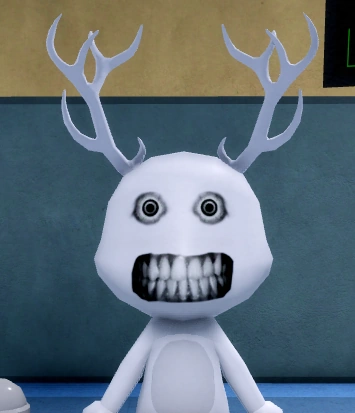
Quick Answer
Small wide circular eyes, black pupils, realistic teeth, or an X-rayed-looking face that appears only in one expression.
Observe the patient's face and reject if the X-rayed features appear. Do not clear the patient only because the face briefly looks normal after an expression change.
What X-rayed Face actually is
X-rayed Face is a visual-layer anomaly that redraws parts of the face with realistic, anatomical detail that does not belong on the patient model. The recorded tells are small wide circular eyes with black pupils and realistic teeth, and the defining behaviour is that the effect appears only in one expression.
When it shows up
It appears on ordinary arrivals. The expression dependency is the trap: the face can look normal before and after the anomalous moment, so a player who looks once, or looks at the wrong time, will see nothing wrong.
Which layer catches it
The window view, held across an expression change. The checklist is not a feature list but a duration: you must watch the face long enough for the anomalous expression to appear, then treat its appearance as conclusive regardless of what the face does next.
How X-rayed Face reads in each layer
| Detection layer | What you see |
|---|---|
| Window | The primary layer. Watch the face through a full expression change rather than at a single moment. |
| Clipboard photo | Can catch it if the photo happened to capture the anomalous expression, but absence there proves nothing. A clean photo does not clear the patient. |
| CCTV | Useful because a fixed camera angle removes your own movement and makes a brief facial change easier to catch. |
| Document | No documented interaction. This entry is decided by the face over time. |
Step-by-step: a real X-rayed Face encounter
- A patient arrives and the resting face matches its baseline.
- You keep watching instead of moving on, and an expression change occurs.
- During that change, realistic teeth appear and the eyes read as small, wide, and circular with black pupils.
- The face then returns to normal. You do not treat the recovery as a clean result.
- You reject on the expression you actually saw, rather than on the one you see now.
False positives
Normal things players reject by mistake while hunting this entry.
- Rejecting a patient for detailed teeth during a wide-open expression, when the recorded tell is realistic anatomy plus the unusual circular eyes together.
- Reading a clean still frame as a clean result. The recorded guidance is specifically that a briefly normal face is not grounds to clear the patient.
- Confusing it with Crooked Face, which keeps sharp distorted teeth and mismatched eye heights rather than realistic anatomy.
- Judging the eyes by size alone, when the distinguishing feature is the combination of small wide circular shape and black pupils.
Often confused with
Entries that share a tell with this one, and how to separate them.
- Frequently confused with Crooked Face and Smiling with Creepy Eyes, all three being face entries. X-rayed Face is the one defined by realistic anatomy appearing intermittently.
- Shares the intermittency problem with Smiling with Creepy Eyes, where an anomalous expression also resolves and makes the patient look normal.
- Because it only affects one expression, every still-frame check including the clipboard photo can pass.
What a wrong call costs
The cost is a wrong call made from confident evidence, because the clean moment is genuine — it is just not the whole picture. Players who clear patients on a single glance lose this entry silently, and the failure looks like a rendering oddity afterwards rather than a missed observation.
Recorded appearance and response
Appearance: The patient's face has small wide circular eyes with black pupils and realistic teeth, creating an X-rayed appearance.
Tell signs: Small wide circular eyes, black pupils, realistic teeth, or an X-rayed-looking face that appears only in one expression.
How to handle: Observe the patient's face and reject if the X-rayed features appear. Do not clear the patient only because the face briefly looks normal after an expression change.
Last re-checked against the live game on September 16, 2026. Last verified 35 days ago — re-check pending.
X-rayed Face FAQ
The face looks normal now. Should I still reject?
If you saw the X-rayed features appear, yes. The recorded guidance is explicit that a patient should not be cleared only because the face briefly looks normal after an expression change. The anomalous expression is the evidence.
What are the tells for X-rayed Face?
Small wide circular eyes with black pupils, realistic teeth, and an X-rayed-looking face that appears in only one expression. The combination is the tell; realistic teeth alone during a wide expression are less conclusive.
Can I catch it on the clipboard photo?
Only if the photo captured the anomalous expression. Because the effect is intermittent, a clean photo is not evidence of a clean patient — the photo simply may have been taken during the normal phase.
How is it different from Crooked Face?
The teeth and eye geometry. Crooked Face has sharp distorted teeth with mismatched eyes at different heights, while X-rayed Face has realistic anatomy paired with small circular eyes.
Related Guides
Other Appearance Check anomalies
Crooked Face · S
Crooked smile, sharp teeth, large mismatched eyes, or eyes positioned unusually high on the face.
Three Eyes · A
Three glowing red eyes, extra eye placement, or an eye count that does not match the patient's normal model.
Hollow Face · A
Dark hollow eyes, sunken facial features, twitching, and a hunched posture.
Smiling with Creepy Eyes · B
Large black-pupil eyes, heavy under-eye bags, and a fixed oversized smile that does not match the normal patient.
Twitching · C
Erratic jerking movements, unnatural head/limb twitches, movement pattern different from all normal patients.
Staring · B
Sustained direct eye contact, head rotation that follows the player, and a gaze that does not break normally.
Tiny Anomaly · C
Unusually tiny body size, high-pitched voice, short-tailed pink bunny model, or multiple glowing red eyes.